
CurAI-It. Bringing Enterprise Engineering to Heritage Archives
Introducing CurAI-It
Having spent over two decades architecting, building, and running enterprise-grade SaaS platforms, you quickly learn where most software falls short. It almost always comes down to the friction between usability and flexibility. Make a system simple, and you inevitably box users into rigid workflows that ignore how they actually work. Make it deeply configurable, and the interface becomes so convoluted that casual users and volunteers bounce right off it.
Striking that balance is at the very core of why we built CurAI-It.
Across the heritage sector, from local historical societies and community trusts to regional archives, private estates, and museums- cataloguing backlogs are an enduring challenge. Rooms full of unindexed physical items, manuscripts, ledgers, and photographs sit in storage simply because manual transcription, metadata entry, and taxonomy tagging demand hundreds of hours.
We wanted to create a platform that pairs deep configurability (custom fields, bespoke classification trees, and tailored prompting) with an interface that is clean, intuitive, and welcoming enough for a volunteer to sit down and start cataloguing immediately.
What is CurAI-It?
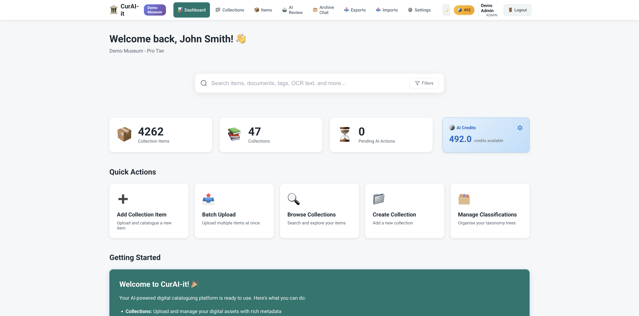
CurAI-It is a cloud-native platform designed to modernise digital asset management for archives, combining structured cataloguing with practical, assistive artificial intelligence.
Crucially, the curator remains firmly in control. The AI acts as an assistant to draft and suggest; your team reviews, edits, and approves every entry.
Assisted AI Metadata & Visual Cataloguing: Upload high-resolution photographs or scans, and the platform suggests accurate titles, rich descriptions, and contextual tags based on your institution's specific cataloguing style and guidelines.
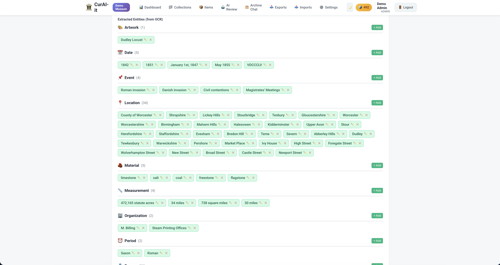
Document OCR & Historical Entity Tagging: Scanned manuscripts, letters, and printed ledgers are transcribed page-by-page using high-precision optical character recognition, automatically picking out historical figures, locations, dates, and materials.
The "Digital Curator" Interactive Archive Chat: A conversational interface that allows curators, volunteers, and researchers to talk directly with their collection. Powered by grounded retrieval-augmented generation (RAG), the system answers questions in plain English, backing up every response with direct citations and links to the source items or transcripts.
Flexible Classification Trees & Custom Fields: Organise complex collections into hierarchical classification structures and custom fields that mirror your exact taxonomy, without forcing items into rigid, one-size-fits-all schemas.
Enterprise-Grade Architecture Under the Bonnet
Too many tools built for the cultural sector are sluggish wrappers around legacy database designs. At Blue Squirrel Software, we approached CurAI-it with the same architectural discipline we apply to high-throughput, mission-critical systems.
Strict Multi-Tenant Isolation: Data security is enforced at a central level. Every tenant has isolated container storage, and database boundaries, ensuring cross-tenant data access is impossible, whilst keeping costs down by sharing underlying infrastructure.
Asynchronous Queue-Driven Pipelines: High-throughput batch imports (handling spreadsheets alongside media ZIP archives), OCR extraction pipelines, and AI processing tasks run asynchronously across background workers, backed by real-time progress streaming to the browser.
Frontier Model Agility & Granular Billing: The backend decouples core business logic from specific AI providers through factory abstractions. The platform is architected to rapidly adopt new frontier vision and language models as the AI landscape evolves. Granular credit and token tracking provide total transparency over processing costs, and hosting our own dedicated AI models as platform demand scales is firmly on our roadmap.
Data Residency & Zero-Training Guarantees: Hosted within secure UK and EU infrastructure, our enterprise agreements guarantee that customer archives, documents, and prompts are never used to train public foundational AI models.
A Different Approach to Product Development
Having worked on both sides of SaaS, as a buyer and a supplier; one pattern is as common as it is frustrating: software vendors flat-out refusing client feature requests (even when full funding is offered) by hiding behind steering committees, user councils, and endless roadmap prioritisation meetings.
We want to break that mould and bring real flexibility back to our clients.
Every collection has unique nuances, whether that involves niche import/export formats, specialised accession numbering schemes, or bespoke metadata workflows. Because CurAI-It is built on a modern, modular architecture, we can rapidly develop bespoke functionality and safely deploy it for specific institutions behind feature flags.
If you need something tailored to make the platform work for your collection, we are open to working with you to build it. Watch this space as we develop and formalise our bespoke-forever guarantee further.
CurAI-It is now live, with packages ranging from a free Basic plan for community groups to scalable Starter, Pro, and bespoke Enterprise tiers for larger public institutions.
Explore the platform, review our features, or arrange a live demonstration at https://curai-it.com/.